
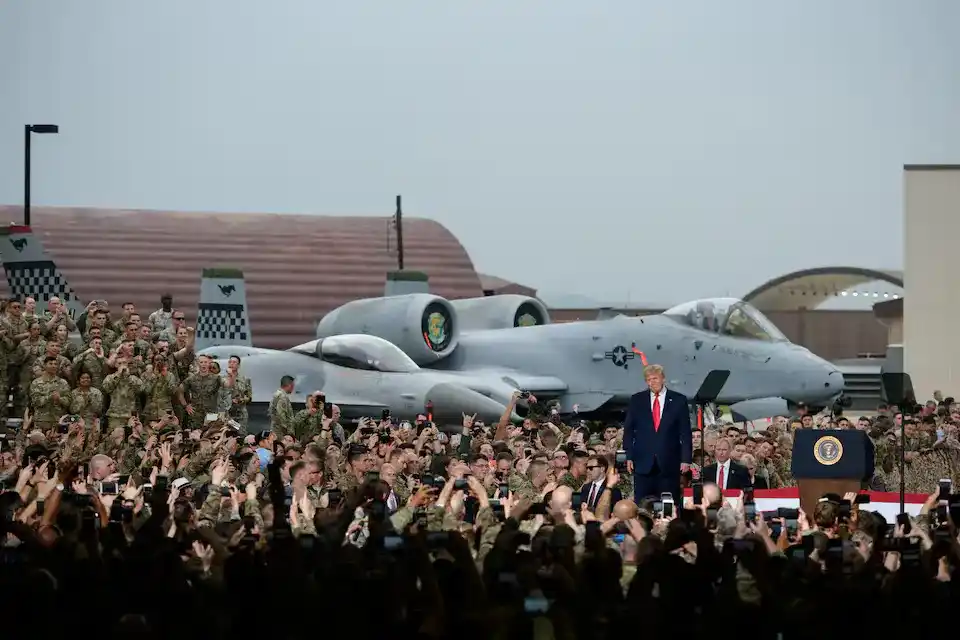
LOGIC.co.id – U.S. President Donald Trump has once again stirred public attention by stating that the cost of stationing tens of thousands of U.S. troops in South Korea and Japan will be part of ongoing trade tariff discussions. This move has sparked concerns in Seoul and Tokyo, both of which have long sought to separate defense issues from economic negotiations.
In a post on the platform Truth Social, Trump stated that talks over burden-sharing in defense would be part of a "single package" of negotiations with South Korea. He made similar remarks during the visit of Japanese officials to Washington earlier this week.
Currently, Japan hosts approximately 50,000 U.S. troops, while South Korea accommodates around 28,500. Both nations rely heavily on the U.S. nuclear umbrella to deter threats from China, Russia, and North Korea, and they serve as key strategic hubs for American military power in the Indo-Pacific region.
Trump has previously threatened to withdraw U.S. troops unless both countries significantly increased their financial contributions. During his first term, he demanded billions of dollars in additional payments from America's East Asian allies.
However, South Korea's First Vice Foreign Minister, Kim Hong-kyun, stated that Washington has not yet formally requested a renegotiation of the Special Measures Agreement (SMA)—the accord governing South Korea’s financial support for U.S. forces. Nevertheless, Seoul has expressed readiness to face all possible outcomes.
South Korean Finance Minister Choi Sang-mok confirmed that the current cost-sharing arrangement is not under renegotiation. Meanwhile, a Japanese government official told Reuters that defense spending should not be linked to trade tariffs.
Political Pressure and Economic Interests
Danny Russel of the Asia Society Policy Institute said Trump’s move to reopen defense cost discussions is a deliberate pressure tactic. "Trump clearly views alliances through a transactional lens and wants to extract economic gains from the U.S. security umbrella," he noted.
At the end of President Joe Biden's term last year, the U.S. and South Korea expedited the signing of a new SMA. The five-year agreement includes an 8.3% increase in South Korea’s contribution, raising it to $1.47 billion in the first year, with subsequent adjustments tied to the consumer price index.
However, a South Korean national security official, speaking on condition of anonymity, admitted that rushing into negotiations may have weakened their current bargaining position. “Now, if we must renegotiate, we’re starting from a higher baseline than if we had waited,” the official said.
Political Context in South Korea and Japan
South Korea’s domestic political situation adds another layer of complexity. President Yoon Suk-yeol was recently impeached following an attempt to impose martial law last December. The country is currently governed by an interim administration, with presidential elections scheduled for June 3.
Meanwhile, Japan hosts the largest number of U.S. troops overseas. Under a 2022 agreement set to expire in March 2027, Japan pays roughly 211 billion yen (around $1.48 billion) annually to support the U.S. military presence.
Bruce Klingner, a senior fellow at the Heritage Foundation, warned that reopening SMA negotiations and tying them to tariffs could increase pressure on South Korea. "This could spark new concerns, including the possibility that South Korea may be forced to make further economic concessions," said the former CIA analyst.
Future of the Alliance and Nuclear Threats
Ongoing doubts over the extent of U.S. commitment to defending South Korea from North Korea’s nuclear threat have led some in Seoul to advocate for developing an independent nuclear arsenal.
Negotiations under a future Trump administration are expected to be more complicated, especially given frequent misinformation. In one of his posts, Trump falsely claimed that defense cost-sharing payments only began during his administration and were stopped by Biden. In reality, SMA agreements have been in place since 1991, with the most recent deal signed just last year.
At a U.S. Congressional hearing last week, Commander of U.S. Forces Korea (USFK), General Xavier Brunson, praised South Korea’s defense spending, weapons purchases, and fighter jet acquisitions from the U.S. “These strategic investments reflect a strong and enduring partnership between our two nations,” he said.