
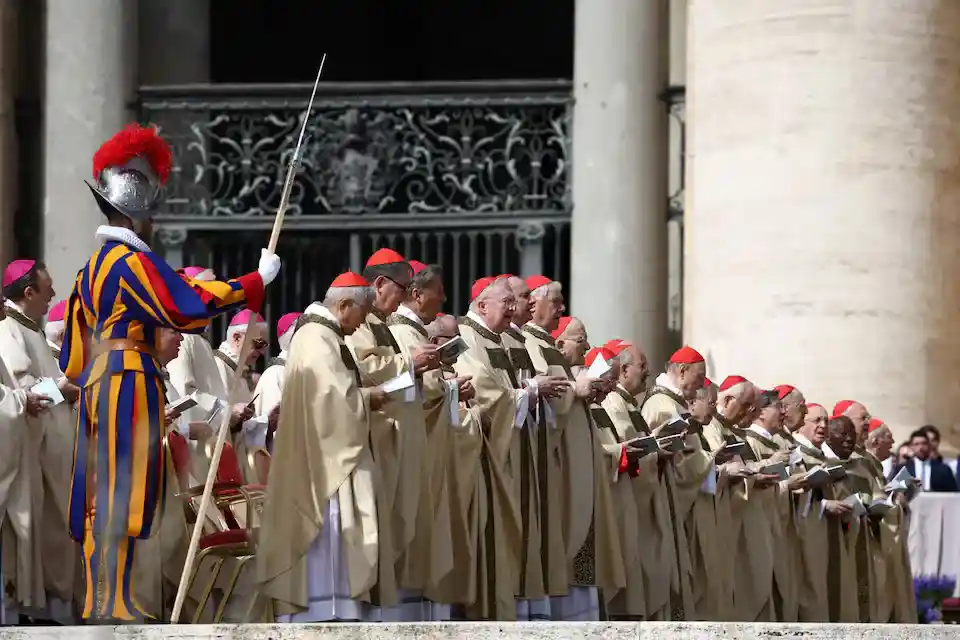
VATICAN, LOGIC.co.id – The Catholic world is in mourning following the death of Pope Francis, which was announced by the Vatican on Monday. Now, attention has shifted to the red-robed cardinals who will decide who becomes the next Pope.
During his papacy, Pope Francis was known for his progressive choices in appointing cardinals, many of whom came from outside Europe. This has sparked hopes that his successor might also come from a non-European region and share similar reformist views aimed at advancing social change within the Catholic Church.
However, the process of selecting a new Pope is highly secretive. Nothing is confirmed until white smoke rises from the Sistine Chapel’s chimney — a signal awaited by Catholics around the world that a new leader has been chosen.
Who Elects the Pope?
Cardinals are senior church officials who assist the Pope in managing key departments in the Vatican and dioceses around the world. When a Pope dies or resigns, cardinals under the age of 80 are eligible to participate in the conclave — a closed-door meeting to elect the next Pope.
The outcome of the vote in the conclave will reveal whether the cardinals — most of whom were appointed by Francis — will continue his progressive direction, or choose to return to more conservative values.
In the coming days, cardinals will begin arriving in Rome to set a date for the conclave’s commencement.
Francis’ Cardinal Appointments
Only a Pope has the authority to appoint cardinals, and these choices play a crucial role in shaping the Church’s future. As of April 21, there are 252 cardinals, with 135 under the age of 80 and thus eligible to vote. Of these, 108 were appointed by Pope Francis, 22 by his predecessor Benedict XVI, and 5 by John Paul II.
Cardinals are appointed during a special ceremony called a consistory, during which they receive a ring, a red biretta (the distinctive square cap), and pledge an oath of loyalty to the Pope — even if it means sacrificing their lives for the faith.
During his tenure, Francis held 10 consistories and appointed many cardinals from developing nations, including Rwanda, Cape Verde, Tonga, Myanmar, Mongolia, and South Sudan. He even appointed a cardinal from Sweden, a country with a very small Catholic population.
Challenging Eurocentric Traditions
Since the Middle Ages, most cardinals have traditionally been Italian, except during a brief period when the papacy was relocated to Avignon, France (1309–1377). The push for internationalization began in earnest under Pope Paul VI and was accelerated by John Paul II — the first non-Italian Pope in 455 years, hailing from Poland.
While Europe still makes up the largest share of voting cardinals (about 39%), this is a decline from the 52% it held when Francis was elected in 2013. Today, Asia and Oceania represent the second-largest group, accounting for around 20%.
In countries like the United States, Pope Francis appeared to deliberately bypass large dioceses such as Los Angeles and San Francisco — known for their conservative archbishops. Instead, he appointed Robert McElroy, a bishop widely recognized for championing Francis’ pastoral agenda, including environmental protection and outreach to LGBTQ Catholics.
A Pope’s Legacy
The number of cardinals appointed by a Pope heavily influences the Church’s direction after his papacy ends. However, this does not guarantee that the next Pope will share the same outlook. In some cases, cardinals have chosen someone with starkly different views — depending on internal Church dynamics and the broader context at the time of election.
For example, Pope Benedict XVI was elected partly due to perceptions that he would uphold the legacy of John Paul II. But after his resignation following the “Vatileaks” scandal, which exposed internal Vatican turmoil, many cardinals believed the Church needed an outsider — leading to the selection of Jorge Mario Bergoglio from Argentina, who became known as Pope Francis.
Although cardinals aged 80 and above cannot vote in the conclave, they still play an important role. They are allowed to participate in preliminary meetings known as the General Congregation, where discussions help shape the profile and qualities desired in the next Pope.